Despite a rocky start to 2026, Nvidia (NASDAQ: NVDA) continues to command strong confidence from Wall Street analysts, with fresh price target upgrades signaling significant upside potential driven by relentless demand for artificial intelligence (AI) infrastructure.
Nvidia stock performance in 2026
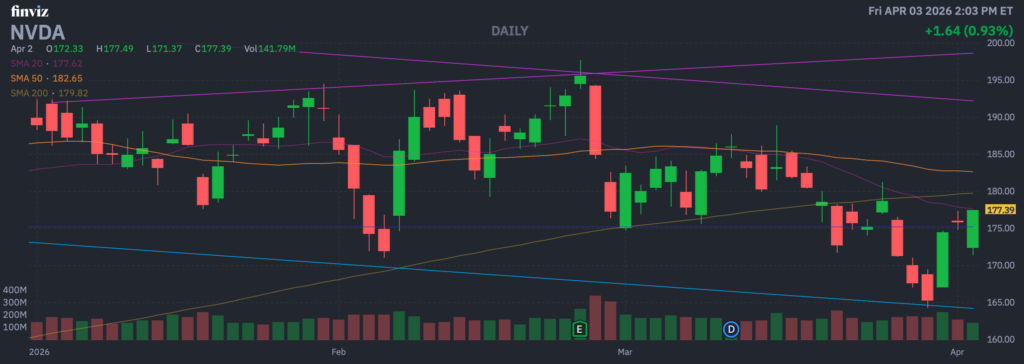
The stock has fallen 6.07% year to date, closing at $177.39 on April 2. While the decline reflects a cooling period after a powerful multi-year rally, analysts widely view the move as a short-term consolidation rather than a shift in the long-term trend. Nvidia continues to sit at the center of the global artificial intelligence buildout, a position that is proving difficult for competitors to challenge.
DBS Bank lifts Nvidia price target to $220 on AI strength
Fresh optimism came on April 2 when Fang Boon Foo of DBS Bank reiterated a Buy rating and raised his 12-month price target to $220 from $180.
The revised forecast implies roughly 24% upside and is rooted in sustained demand for Nvidia’s AI chips. According to Foo, the rapid evolution of artificial intelligence models is increasing the need for high-performance computing infrastructure, an area where Nvidia continues to dominate.
He also pointed to ongoing expansion in data center capacity worldwide, as hyperscalers and enterprises invest aggressively to support AI workloads.
Analyst consensus signals significant upside potential
The latest upgrade is part of a broader wave of bullish sentiment across Wall Street. At the end of March, Cody Acree, a senior semiconductor analyst at Benchmark, reiterated his Buy rating on Nvidia and set a $250 price target, implying roughly 41% upside from current levels.
Similarly, Rick Schafer, managing director and senior semiconductor analyst at Oppenheimer, maintained his bullish stance on the stock, reaffirming a Buy rating as demand for AI infrastructure continues to strengthen.
Fang Boon Foo’s credibility adds further weight to the overall bullish narrative. On TipRanks, he holds a 68% success rate with an average return of 36.3% per rating, reinforcing confidence in his outlook.
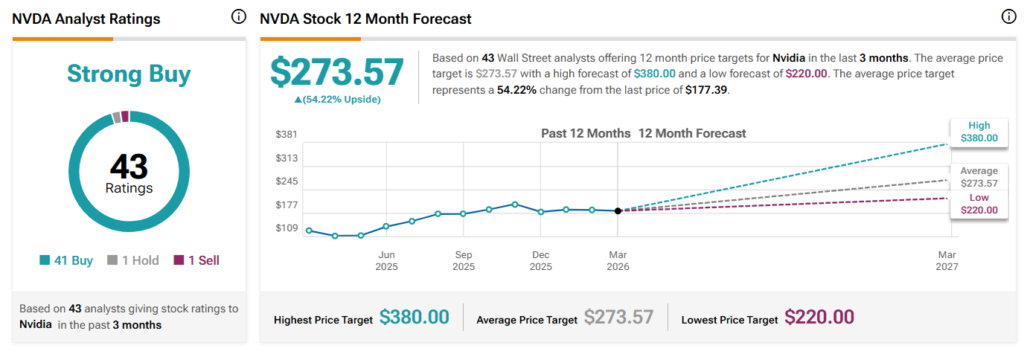
Across the Street, Nvidia currently carries a Strong Buy consensus rating, with an average 12-month price target of $273.57. That figure points to more than 50% upside from the latest closing price, highlighting how overwhelmingly positive sentiment remains.
Out of 43 recent analyst ratings on TipRanks, nearly all recommend buying the NVDA shares stock, with only one Neutral and one Sell view recorded.
AI boom and product pipeline continue to drive Nvidia’s growth story
Much of the confidence surrounding Nvidia stems from its dominant role in the AI ecosystem. Since the surge in artificial intelligence adoption began in late 2022, the company has established itself as the backbone of AI computing, supplying the GPUs required to train and deploy large-scale models.
Looking forward, Nvidia’s product roadmap continues to reinforce its leadership. The upcoming Vera Rubin architecture is expected to build on the success of the Blackwell platform, delivering further performance gains that could extend the company’s competitive edge.
At the same time, Jensen Huang has outlined an ambitious long-term vision, highlighting a potential $1 trillion revenue opportunity tied to AI, data centers, and accelerated computing. That narrative continues to resonate strongly with investors and analysts alike.
Nvidia stock outlook for 2026
While near-term volatility remains part of the picture, Nvidia’s core investment thesis appears unchanged. Strong demand for AI infrastructure, a robust innovation pipeline, and consistent analyst support continue to frame the stock as one of the most compelling growth stories in the market.
With Wall Street steadily raising price targets and reaffirming bullish ratings, Nvidia’s recent pullback may ultimately be remembered as a pause within a much larger upward trend.
Featured image via Pexels / UMA media